
About the event
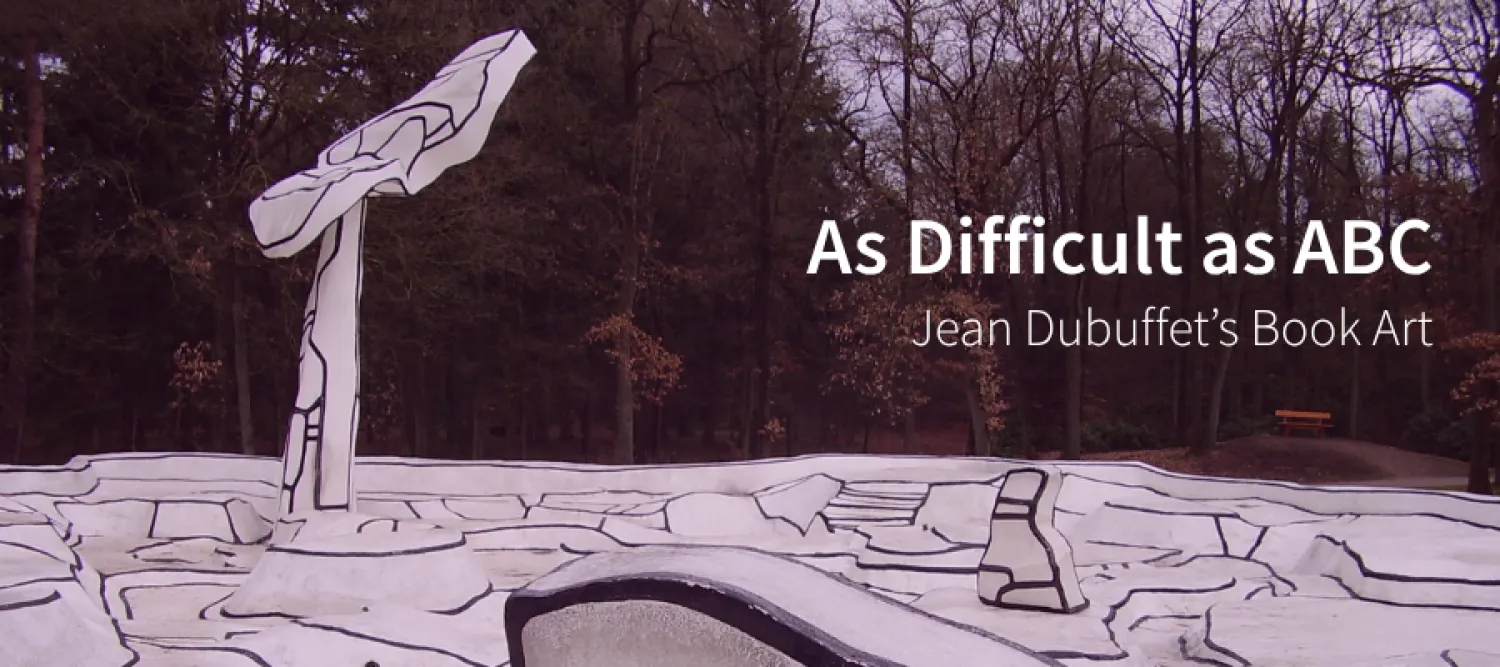
Throughout his long career and in tandem with his intensive production of paintings, prints, drawings, sculptures, monuments, and large sculpted environments, Jean Dubuffet wrote prolifically, generating a large body of commentaries on his own art practice and that of the Art Brut artists whom he championed. Those aesthetic writings figure prominently in the criticism on his work.
By contrast, little attention has been paid to the small but significant corpus of creative writings, livres d’artiste, artist’s books, and other visual-verbal work that Dubuffet produced between the 1930s and 1980s and that comprises a heterogeneous body of prose, verse, and text/image volumes. Likewise, although the impact of children’s drawing and painting on his art practice has been discussed in the criticism, his receptiveness to other early learning materials remains largely uncharted territory.
Professor Duffy's talk offers a sampler of Dubuffet’s creative writing and book art and situates them in relation to traditional children’s book genres, to contemporary writing by and for children, and to the pedagogy and practice of educational theorists and teachers associated with the École moderne movement. Focusing first on two of Dubuffet’s artist’s books — 'Ler dla campane' and L’Hourloupe — both produced at pivotal moments in his career and both requiring of their reader-viewers sophisticated linguistic and visual decoding skills, the talk concludes with an analysis of the sets of largely unknown, seemingly whimsical decorated initials or Lettrines from 1960-1961. Dubuffet produced these as he was making the transition between the predominantly sober landscapes and groundscapes of the 1950s and the colourful, busy, carnivalesque and linguistically challenging cityscapes or urban signscapes of Paris Circus.
About the speaker
Jean Duffy is Emeritus Professor of French. She was obtained her MA from the University of Glasgow, and her PhD from the University of Oxford, before being appointed to the Chair of French at the University of Edinburgh in 1999. She was also General Editor of French Studies from July 2007 until January 2012.
Professor Duffy has published extensively on the nouveau roman, on the relationship between literature and the visual arts and on the role of ritual in modern French narrative. Her publications include monographs on Claude Simon and Michel Butor which examine a range of issues relating to verbal/visual inquiry: the artwork as narrative generator and mise en abyme, the exploitation of the ‘artistic biography’ as intertext, visual/ textual collaboration and the exchange and adaptation of visual and literary concepts and practices.
Her 2011 monograph, 'Thresholds of Meaning', explores the centrality within recent French fiction and autofiction of the themes of passage, ritual and liminality and examines the thematic continuity which links this work with its literary ancestors of the 1960s and 1970s. Her most recent book, 'Perceiving Dubuffet: Art, Embodiment, and the Viewer' (2021), offers a comprehensive reconsideration of Jean Dubuffet’s work which contextualizes it within contemporary developments in phenomenology and examines the central role played by questions relating to embodiment in the evolution of his aesthetic thinking and artistic practice.
How to attend
This event is open to all, and free to attend. No registration is required, you can simply come along on the day!
Are you interested in studying Intermediality?
As the first UNESCO World City of Literature, home of the Edinburgh International Festival and a major cultural hub, Edinburgh is the ideal place for the study of intermediality. Our one-year taught masters programme draws on world-class teaching and research expertise across media, from literature to film, music, painting, photography and visual culture more widely.
The programme will make you conversant with intermedial theory and equip you with the critical tools and historical background for understanding and analysing a wide range of intermedial phenomena across different periods and cultures. It can also be completed part-time over two years.